

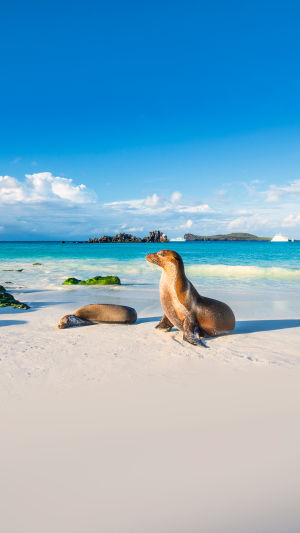
Imagine walking along a sun-drenched beach in the Galápagos Islands and spotting not one, but two playful sea lions lounging near the shore. We are instantly drawn to their relaxed yet curious energy.
These two companions, often seen resting together, give us a rare chance to observe social behavior up close. Their interactions are playful, sometimes gentle nudges, other times small wrestling matches, reminding us how lively and expressive these animals can be.
Even from a short distance, we notice their personalities shine through—the larger one seems protective and confident, while the smaller one appears inquisitive and energetic.
<h3>Who They Are</h3>
These two sea lions belong to the species Zalophus wollebaeki, found only in the Galápagos Islands and occasionally on La Plata Island. They are the smallest of the sea lion species, but their size doesn’t limit their energy or adaptability. One is slightly larger—likely the older male—and the other smaller, perhaps a younger female or subadult.
Observing them together helps us notice differences in size, posture, and even playful personality traits. We can also see the importance of companionship in their daily routines. They rest together to stay warm and alert, and their bond appears both social and practical, especially when navigating beaches crowded with rocks, sand, and occasional human visitors.
<h3>Distinctive Features Up Close</h3>
Standing on the warm sand, we can see that the larger sea lion has a broad chest and a noticeable crest on its forehead, while the smaller one has a smoother, flatter head. Both have sharp whiskers and expressive eyes that seem to track every movement around them. Their flippers are long and leather-like, curving backward for agility.
On land, they may appear clumsy, but we quickly notice their strength and balance as they shift positions or move closer to the waves. In the water, we are amazed at their grace as they glide effortlessly, changing directions with precision using their powerful flippers. Their ability to control each flipper independently allows them to twist and turn with ease, making even complex maneuvers look natural and playful.
<h3>Watching Their Play</h3>
We love observing how these two companions interact. They roll on the sand, nuzzle each other, and occasionally dart into the surf for a quick swim. Their playful wrestling is gentle yet full of energy, a mix of curiosity and social bonding. Even small gestures, like one nudging the other’s side or chasing a floating leaf, reveal their intelligence and social awareness.
Watching them reminds us that wildlife is not just about survival—it’s also about connection, learning, and joy. Each playful splash or quick dash into the water captivates our attention, making us feel like part of their world for a few moments.
<h3>Changing Colors and Growth</h3>
These sea lions also show us nature’s small surprises. When wet, their fur looks deep brown, almost black in the shade; when dry under the sun, the color lightens and even shines golden at certain angles. The smaller sea lion’s fur is slightly lighter, hinting at age and gender differences. Observing them helps us understand growth stages—from pups with soft, longer hair to young adults shedding for mature coats, typically around 4–5 years old.
We also notice subtle physical differences: the male’s chest and shoulder area are bulkier, while the female’s movements appear more agile and flexible. Their whiskers and expressive eyes make it easy for us to feel connected, even at a distance.
<h3>Life on the Islands</h3>
We can see that life here is a delicate balance. These two sea lions enjoy sunbathing, resting on rocks, and swimming along the coast, but they must also navigate human presence, predators, and the natural environment. Their companionship helps them stay safe and engaged. On land, they take turns keeping watch while the other rests or plays.
In the water, their coordination seems almost instinctive, moving as a pair to explore shallow coves or chase small waves. Observing them teaches us patience and appreciation for how wildlife adapts to changing conditions. It also reminds us to maintain a respectful distance and minimize disruption to their natural behaviors.
<h3>Last Moments with Friends</h3>
Lykkers, spending time with these two Galápagos sea lions has left us smiling and inspired. Their playful curiosity, close bond, and graceful movements reveal a side of nature that is both gentle and full of life. Each encounter teaches us patience, joy, and a deeper appreciation for wildlife. Watching them rest on the sand, tumble playfully, and glide through the waves, we feel a sense of wonder and connection that lingers long after we leave.
As we step away from the beach, we carry with us a promise to respect and protect these incredible creatures whenever we return to the islands.


