

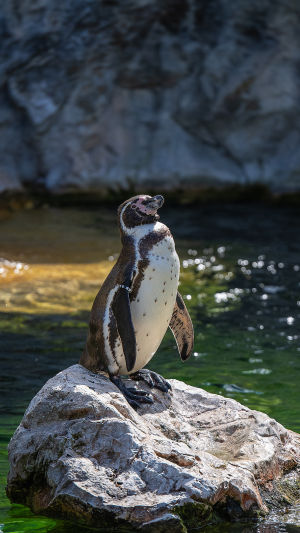
Penguins are one of the most fascinating birds in the world. Even though they cannot fly, they have perfectly adapted to life in the water.
Almost all penguin species live in the Southern Hemisphere, except for the Galapagos penguin near the equator.
When we watch them, we notice a perfect balance between life on land and life in the ocean. Penguins are playful yet disciplined, social yet independent, making them a favorite of wildlife lovers everywhere.
<h3>Body Design and Swimming Skills</h3>
Penguins are built for swimming like few other birds. Their wings have evolved into strong flippers, allowing them to “fly” underwater with incredible speed and agility. Their black-and-white feathers work as camouflage: dark backs blend with deep water from above, and white bellies match the bright ocean surface from below.
Penguins’ sharp, barbed tongues and strong jaws help them catch slippery prey like shrimp, fish, and squid. Sometimes, we see them dive as deep as 500 feet (150 meters), twisting and turning mid-water to catch their next meal. Watching them underwater feels like seeing a miniature submarine in action.
<h3>Life Between Land and Sea</h3>
We often think about how penguins divide their lives between land and sea. On average, they spend about half their time on land to rest, breed, and raise chicks, and the other half in the ocean hunting for food. The emperor penguin is the largest species today, standing around 1.1 meters (3 feet 7 inches) tall and weighing about 35 kilograms (77 pounds).
On the smaller side, little blue penguins, also called fairy penguins, are just 30–33 centimeters (12–13 inches) tall and weigh 1.2–1.3 kilograms (2.6–2.9 pounds). Spending time on land allows them to socialize, form strong pair bonds, and build nests from pebbles, showing how community life is just as important as survival skills.
<h3>Climate, Habitat, and Adaptation</h3>
Penguin sizes often match their environment. Large penguins thrive in cold climates like Antarctica, while smaller penguins live in temperate or tropical regions. This adaptation helps them conserve energy and survive efficiently in different habitats. Long ago, some prehistoric penguins were enormous, comparable in height and weight to humans!
During the late Paleocene and early Eocene, subantarctic regions were home to giant species, even near the equator, when the climate was much warmer than today. These examples remind us how penguins have evolved over millions of years to adapt to changing climates.
<h3>Diet and Hunting Techniques</h3>
We are always amazed at how penguins hunt. They use their flippers to dive and chase prey with remarkable agility. Their barbed tongues prevent slippery fish and squid from escaping. Penguins are opportunistic feeders, meaning they adjust their diet based on what is available in the ocean. They can even travel tens of miles in a single day searching for food.
Some species, like the macaroni penguin, can eat thousands of krill each day, showing how incredible their stamina is. This flexibility ensures survival even when their favorite prey becomes scarce.
<h3>Social Life and Communication</h3>
Penguins are social creatures. We can see large colonies with thousands of birds huddling together to stay warm, especially in extreme cold. They communicate with each other using unique calls, head movements, and even body postures.
Each penguin has a distinctive voice, helping mates and chicks recognize each other in noisy colonies. Watching this social interaction reminds us how cooperation and communication are key to survival—something we can relate to in our own lives too.
<h3>Life Lessons from Penguins</h3>
Observing penguins teaches us about resilience, teamwork, and adaptation. We see how they cooperate, protect their young, and use their strengths wisely. Penguins are playful yet disciplined, social yet independent. Their lives show that balancing work, rest, and relationships is vital, even in extreme conditions. They also remind us that a sense of curiosity and fun helps us face challenges with energy and creativity.
<h3>Why We Love Penguins</h3>
Lykkers, penguins are more than just cute birds waddling on ice. They are skilled swimmers, careful parents, and amazing survivors. Observing them reminds us to enjoy small joys and face challenges with courage.
The next time we watch a penguin in the wild, in a documentary, or even in a picture, we’ll appreciate just how extraordinary these creatures truly are. They teach us that life is full of surprises, valuable lessons, and the power of community and resilience.
Penguins in 4K / Antartica
Video by 8K VIDEOS ULTRA HD


