

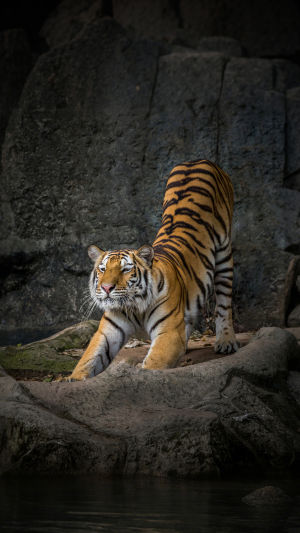
We often see tigers as strong and fast hunters, but in daily life they also spend long hours resting. After sleep or long periods of quiet rest, a tiger slowly stretches its body.
This simple action may look lazy, yet it is an important part of its routine.
Stretching helps the body shift from rest to activity and keeps muscles flexible and ready. It connects calm moments with power in a natural way. When the tiger wakes up, the stretch becomes a gentle signal that its body is preparing for movement and awareness.
<h3>Body Movements During the Stretch</h3>
When a tiger begins to stretch, it usually takes a deep breath first. The chest expands as air fills the lungs. Then the muscles start to activate. The tiger extends its front legs forward while lowering its head toward the ground. At the same time, the back curves gently and the spine lengthens. The claws may spread as the paws press firmly against the surface.
After stretching the front body, the tiger straightens its back legs and lifts its hips slightly. The tail moves slowly to maintain balance. Sometimes it bends its body to one side and repeats the movement on the opposite side. These smooth actions last only a few seconds, but many muscle groups work together. The movement looks relaxed, yet it requires coordination and control from the whole body.
<h3>Why Stretching Is Important for Survival</h3>
We know tigers depend on strong muscles and flexible joints to survive in the wild. After hours of sleep, muscles can feel stiff because of reduced movement. Stretching improves blood circulation and increases oxygen flow to the tissues. Better circulation reduces stiffness and helps muscles recover from previous activity. Flexibility is also important for hunting.
A tiger needs fast acceleration, powerful jumps, and quick turns. If the body is stiff, movement becomes slower and less efficient. Stretching prepares the spine, shoulders, and legs for sudden action. It protects joints from strain and supports long-term physical strength. This behavior is not random. It is part of the tiger’s natural adaptation that helps maintain physical condition in changing environments.
<h3>Stretching After Rest and Before Activity</h3>
Tigers sleep many hours each day to save energy. Rest allows the body to recover from hunting and walking across large territories. After waking up, stretching becomes a natural transition from sleep to movement. We often observe this action in shaded forest areas, near water sources, or under thick trees. The tiger slowly rises, stretches, and then begins to walk or observe its surroundings.
Before hunting, it may stretch quietly while watching prey from a distance. This routine activates muscles and sharpens focus at the same time. Stretching also happens after physical effort. After chasing prey or traveling long distances, the tiger rests briefly and then stretches again. This helps relax tight muscles and maintain balance between activity and recovery. Through this cycle, the body stays prepared for the next challenge.
<h3>The Meaning of the Lazy Moment</h3>
The lazy stretch shows balance rather than weakness. We understand that power does not always mean constant motion. Sometimes strength appears in calm and steady actions. Even during stretching, the tiger remains alert. Its ears listen carefully to sounds and its eyes observe movement around it. The body relaxes, but awareness stays strong. This combination of relaxation and attention reflects survival skills developed over time.
The quiet moment also shows smart energy management. Tigers avoid wasting unnecessary energy. They rest to restore strength and stretch to prepare for action. This rhythm helps them survive in environments where food may not always be easy to find and threats may appear suddenly.
<h3>Health and Habitat Support</h3>
We can learn about a tiger’s health by observing its movement. A healthy tiger stretches smoothly and confidently. Its muscles move freely and its joints show flexibility. If a tiger avoids stretching or moves stiffly, it may indicate physical discomfort or injury. Good habitat conditions play a key role in supporting natural behavior. Large forest areas with minimal disturbance allow tigers to move freely.
Open space gives them room to rest, stretch, walk, and mark territory without stress. However, habitat loss and human expansion reduce available space. When forests shrink, natural behaviors become harder to express. Protecting wild land ensures that tigers can maintain their daily routines, including simple but important actions like stretching. Conservation efforts help create safe environments where these behaviors can continue.
<h3>Connection Between Power and Calm</h3>
The action of a tiger stretching lazily reminds us that power and calm coexist. Strength is not shown only during hunting or running. It is also visible in preparation and recovery. We see how the body warms up before activity and relaxes after effort. This natural cycle keeps the tiger healthy and efficient. The stretch represents readiness for survival and respect for energy balance.
Lykkers, when we observe this quiet moment in the wild, we witness harmony between rest and strength. Protecting tigers and their habitats allows future generations to see these natural movements. Let us value and support wildlife conservation so that this powerful animal can continue stretching freely in the wild.
Tiger stretch and scratch!
Video by Susann Mesna


