

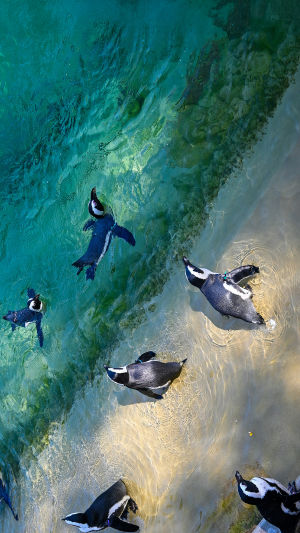
On icy coasts and in salty seas, penguins — the charming, tuxedo clad seabirds — have carved out a life that seems tailor made for the most extreme environments on Earth.
Though many people instantly picture Antarctica, the world of penguins extends beyond ice: different species adapt to varied climates, forage deep under water, and display fascinating social behaviors.
Drawing on expert sources from National Geographic and BBC Earth, here is an engaging look at what makes penguins so remarkable.
<h3>Penguins Are Master Swimmers, Not Flyers</h3>
One of the most iconic facts about penguins is that, while they are birds, they can't fly in the air. Their wings have evolved into powerful flippers that make them exceptional swimmers — a form of underwater “flight.”
Underwater, penguins use stiff flippers and hydrodynamic bodies to pursue fish, squid, and crustaceans. Gentoo penguins are the fastest swimmers, reaching speeds up to about 15 miles per hour — faster in water than most birds can swim on the surface.
On land, their waddling gait is iconic but inefficient, which is why species in icy regions sometimes toboggan: sliding on their bellies while kicking with their feet to move quickly across snow and ice.
<h3>Penguins Live in Diverse Environments</h3>
Although many people imagine penguins only on Antarctic ice, they actually live across an array of Southern Hemisphere habitats. Most species are found on cool sub Antarctic islands, temperate coasts, and even near the equator — the Galápagos penguin, for example, is the only species living north of the equator.
This diversity reflects the adaptability of penguins. They thrive where rich marine food is available, using an insulating layer of dense feathers and a thick layer of blubber to withstand cold temperatures — even when the air is near freezing and the water frigid.
<h3>Social Behavior and Colony Life</h3>
Penguins are highly social birds that spend much of their lives in colonies, sometimes numbering in the thousands.
These large gatherings serve multiple purposes: they help conserve warmth, reduce predation risk, and coordinate complex breeding behavior. Penguins use a range of vocalizations to communicate within these noisy colonies.
Interestingly, many species are monogamous during the breeding season, and parents share incubation duties. In some species, both mother and father may take turns keeping eggs warm and feeding chicks.
<h3>Penguins Exhibit Unique Physical Adaptations</h3>
Penguins' bodies are perfectly adapted for aquatic life. Their feathers are small, densely packed, and coated with oil to provide waterproofing and insulation.
Beneath their feathers, a layer of blubber helps maintain body heat in cold water. Their distinctive black and white coloring is not for style — it's protective counter shading: from above, the dark back blends with the ocean depths, and from below, the white underside matches the brighter surface light.
<h3>Catastrophic Molt and Life Cycle</h3>
Penguins undergo a remarkable process called a catastrophic molt, where they lose and replace all their feathers at once.
This makes them temporarily unable to swim or forage, so they spend weeks on land fasting while new feathers grow. It's a unique adaptation among birds that fish intensively, reflecting the importance of waterproof plumage for feeding and survival.
Penguins are also long lived birds, with many species surviving 15 to 20 years in the wild. Their life history includes deep ocean dives and complex social interactions that make them fascinating subjects for study and admiration.
<b>Reflection:</b> Penguins challenge our assumptions about what it means to be a bird. They give up flight in the air but gain a mastery of the sea, demonstrating that evolution adapts life in astonishing ways. Watching a colony waddle, slide, and dive reveals not just a quirky animal, but a creature exquisitely suited to its environment — a reminder that survival often comes through specialized ingenuity rather than simple strength.


