

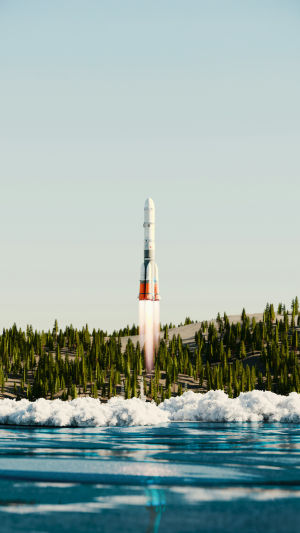
SpaceX's Falcon 9 rocket is more than just another launch vehicle—it has fundamentally altered how the world approaches spaceflight.
Designed as a reusable, orbital class launch system, Falcon 9 has enabled routine access to Earth orbit for satellites, cargo, and crew, significantly lowering costs and increasing launch cadence.
Its capability to land and refly its first stage stands as one of the most important technological advances in modern rocketry.
<h3>Design and Key Features of Falcon 9</h3>
Falcon 9 is a two stage, partially reusable rocket created and manufactured by SpaceX. The first stage is powered by nine Merlin engines, producing the majority of power at liftoff, while the second stage uses a single Merlin Vacuum engine optimized for spaceflight.
Below are the basic physical and performance characteristics of Falcon 9:
<b>1. Physical Specifications</b>
• Height: approximately 70 m (230 ft)
• Diameter: about 3.7 m
• Mass at launch: ~549,000 kg
<b>2. Payload Capacity</b>
• Up to ~22,800 kg to Low Earth Orbit
• Up to ~8,300 kg to Geostationary Transfer Orbit
These figures illustrate Falcon 9's versatility in serving both commercial and governmental missions.
Crucially, Falcon 9 is designed for reusability—the first stage returns to Earth after launch for vertical landings on land or offshore platforms, ready to fly again. This innovation has dramatically reduced launch costs and increased operational tempo.
<h3>A Milestone in Commercial Human Spaceflight</h3>
Beyond delivering satellites, Falcon 9 has played a central role in crewed spaceflight. Paired with SpaceX's Crew Dragon spacecraft, it has been used to transport astronauts to the International Space Station. This marked the first time a commercial rocket system carried humans into orbit, highlighting Falcon 9's reliability and safety credentials.
Space.com's coverage underscores how Falcon 9's integration with crewed missions has sealed its position as a pivotal launch vehicle empowering both scientific and commercial endeavors.
<h3>Operational Success and Versatility</h3>
Since its introduction, Falcon 9 has become one of the most frequently launched rockets in history, used for missions ranging from satellite deployment to cargo resupply for space stations. Its workhorse status is due in part to the combination of robust engineering and a design philosophy that emphasizes rapid turnaround and reusability.
This consistency in performance has allowed SpaceX to capture a broad segment of the global launch market, providing services for government agencies, private companies, and international partners alike.
<h3>Impact on Cost and Space Industry Dynamics</h3>
Falcon 9's reusable first stage has reshaped industry economics. Before Falcon 9, rockets were almost always expendable, meaning the entire launch vehicle was discarded after each mission. The reuse of the first stage's most expensive components dramatically lowers the cost per launch.
Space.com reports that this shift has not only benefited SpaceX's competitiveness but has also pressured legacy launch providers to rethink their approaches to cost and frequency.
<h3>Conclusion: A New Chapter in Spaceflight</h3>
Falcon 9 symbolizes a watershed moment in the evolution of space transportation. By combining reusable technology with versatile mission capability, it has democratized access to Earth orbit in ways previously considered unrealistic.
Its success shows how innovation—rooted in engineering rigor and willingness to push boundaries—can yield real, measurable change. Looking ahead, Falcon 9's legacy will endure not only in its own continued flights but in how its achievements shape future rocket design and the path toward more ambitious destinations beyond Earth orbit.


